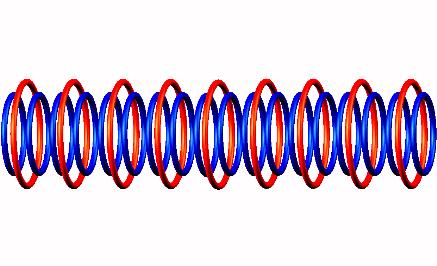
Blue toruses = 18 protons
Red toruses = 9 nuclear electrons
Atomic number of F18 = protons (17) - nuclear electrons (8) = 9 with structure 9D.
Fluorine 18 transform by positron emission from a source of a photon decomposition,
while electron component of the photon captured by
Fluorine 18 and Oxygen 18 produced (stable).
Click on image for Fluorine 18 nuclear structure.


| F14 | F15 | F16 | F17 | F18 | F19 | F19i |
| H | He | Li | Be | B | C | N | O | F | Ne | Na | Mg | Al | Si | P | S | Cl | Ar |
| K | Ca | Sc | Ti | V | Cr | Mn | Fe | Co | Ni | Cu | Zn | Ga | Ge | As | Se | Br | Kr |
| Rb | Sr | Y | Zr | Nb | Mo | Tc | Ru | Rh | Pd | Ag | Cd | In | Sn | Sb | Te | I | Xe |
| Cs | Ba | La | Ce | Pr | Nd | Pm | Sm | Eu | Gd | Tb | Dy | Ho | Er | Tm | Yb | Lu | Hf |
| Ta | W | Re | Os | Ir | Pt | Au | Hg | Tl | Pb | Bi |
The nuclear composition of the Fluor-18 isotope, nuclear structure of the F18 atom, nucleus of the Fluor-18 element. Positron emission decay of Fluorine-18 with gamma photon capture.
The structure of F18 nucleus appears balanced and symmetrical, yet it is still electron-deficient. Presumably, extremely high pressure stabilizes these longer structures in a neutron star.